
For years, supply chain visibility largely meant tracking shipments through a series of disconnected scan events. The push for increased, end-to-end visibility, though, is heating up with another logistics provider announcing a new solution.
Penske Logistics this week introduced Supply Chain Insight, a new visibility and analytics platform designed to bring together transportation, warehousing, inventory, and partner data into a unified operational view, as reported by Supply Chain 247. The platform reflects a broader industry shift underway as companies move beyond fragmented visibility toward more continuous, end-to-end operational awareness and follows a similar announcement by UPS, which rolled out RFID scanning across its network.
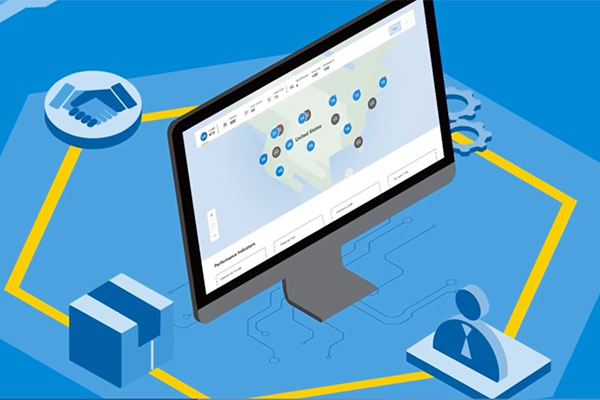
The Penske platform aggregates data from transportation and warehouse operations alongside outside carriers, third-party warehouses, and partner systems into a single dashboard environment. Penske said the goal is to help companies identify disruptions earlier, respond faster to exceptions, and improve coordination across increasingly complex supply chain networks.
“Our goal with the launch and development of Supply Chain Insight is to help our customers accelerate supply chain performance,” said Jeff Jackson, president of Penske Logistics. “This new platform provides customers with an unprecedented and unified view across their highly complex transportation and warehousing operations. It connects data that is often split across separate systems, giving teams a clearer picture of what’s happening across their supply chain.”
The launch comes as visibility itself is evolving inside supply chain operations. Historically, many visibility platforms focused primarily on transportation milestones and shipment tracking. But companies increasingly want broader operational intelligence that connects inventory, warehouse activity, transportation flows, and order execution into a more synchronized environment.
That shift has accelerated as supply chains face persistent disruption, labor volatility, geopolitical instability, tariff uncertainty, and growing pressure to improve execution speed.
In recent years, technologies such as RFID, IoT sensors, computer vision, and AI-driven analytics have expanded what organizations can monitor in real time. The industry is moving from periodic updates toward continuous visibility models capable of creating near real-time operational awareness across facilities, inventory, freight, and supplier networks.
That evolution was highlighted recently UPS’ large-scale RFID rollout initiative, which signaled how visibility strategies are increasingly focused on persistent inventory and package awareness rather than isolated barcode scans. Instead of relying solely on manual touchpoints, newer visibility architectures are designed to create automated streams of operational data that continuously update as goods move through the network.
The broader goal is not simply seeing more data, but reducing the lag time between operational events and decision-making.
That challenge becomes particularly important during disruption events. In many organizations, operations teams and transportation teams still operate from separate systems and often respond to disruptions with incomplete or delayed information. The result can be what some industry observers describe as a “tug-of-war” between fulfillment priorities and transportation realities, where late operational adjustments create downstream transportation inefficiencies, added costs, and service failures.
Platforms like Supply Chain Insight are designed to help close some of those gaps by creating a more synchronized operational picture across functions.
One of the central challenges Penske is attempting to address is data fragmentation. Transportation management systems, warehouse management systems, inventory systems, and partner platforms often operate independently, making it difficult for companies to identify exceptions quickly or understand how disruptions in one area impact the broader network.
The addition of AI-based querying also reflects another growing trend across the supply chain software market: shifting visibility platforms from passive monitoring systems toward more intelligent orchestration layers capable of surfacing insights, prioritizing risks, and eventually helping automate operational responses.
That may represent the next phase of supply chain visibility strategy. For many organizations, visibility alone is no longer enough. The competitive advantage increasingly comes from how quickly companies can translate operational signals into coordinated action across transportation, warehousing, inventory, and fulfillment operations.
Information from Supply Chain 247 was used with permission in this report.
SC
MR

More Supply Chain Visibility
- Nexus suppliers: Hidden anchors of resilience in decentralized supply chains
- Penske Logistics jumps into the end-to-end visibility pool as industry options grow
- Closing the execution gap: Why supply chain investments still struggle to deliver results
- UPS RFID rollout signals next phase of supply chain visibility
- Spend aggregation gives way to new approaches in a tariff-driven supply chain
- More Supply Chain Visibility
What's Related in Supply Chain Visibility
 Explore
Topics
Procurement & Sourcing News
- Why companies blame the wrong supplier … and miss the real failure
- NextGen Supply Chain Conference unveils agenda focused on AI, execution and the future of leadership
- From fragmented negotiations to coordinated negotiation performance: an AI-enabled approach
- Supply chain resilience isn’t a data problem; it’s a judgment problem
- Why your supply chain risk management plan will fail
- When component verification becomes operational
- More Procurement & Sourcing
Latest Procurement & Sourcing Resources
Subscribe

Supply Chain Management Review delivers the best industry content.

Editors’ Picks



